
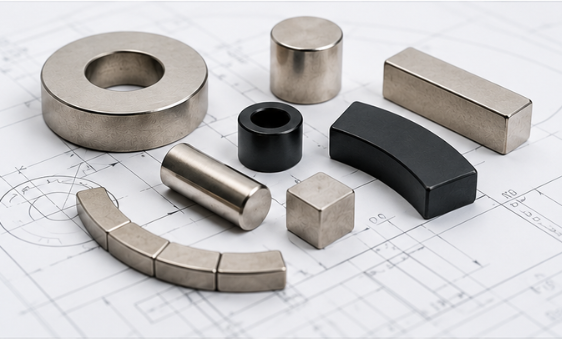
Selecting the right permanent magnet involves more than choosing a material or grade. Magnet geometry plays an important role in how a magnetic field is distributed, how the magnet integrates into an assembly, and how effectively it performs within an application.
Two magnets made from the same material and grade can produce different results simply because of their shape.
At SuperMagnetMan, we work with engineers, researchers, universities, and product developers who use stock magnets for prototyping, proof of concept testing, and low volume production. One of the most common questions we receive is:
Does magnet shape really matter?
It absolutely does!
Understanding why different magnet shapes exist can help simplify design decisions, improve performance, and reduce development time before moving to production.
Why Magnet Geometry Matters
Every magnet shape is designed to solve a different engineering challenge.
Some applications require a compact magnet that fits within limited space. Others require a shaft to pass through the center of the magnet. Motor designs often require curved magnets that follow the rotor, while automation systems may benefit from magnets with large flat mounting surfaces.
Rather than asking, “Which magnet shape is best?”
A better question is, “Which magnet shape best supports my mechanical and magnetic requirements?”
Once the application requirements are understood, selecting the appropriate geometry becomes much more straightforward.
Disc Magnets
Disc magnets are one of the most common permanent magnet shapes because they are simple, versatile, and available in a wide range of sizes.
Their compact geometry makes them an excellent starting point for prototype development and general purpose magnetic applications.
Why Engineers Use Disc Magnets
- Compact and easy to integrate
- Available in many diameters and thicknesses
- Simple to mount using adhesives or mechanical retention
- Well suited for rapid prototyping
- Available in multiple materials and grades
Typical Applications
- Hall effect sensors
- Reed switches
- Medical devices
- Consumer electronics
- Robotics
- Magnetic holding
- Laboratory equipment
Engineering Insight
Disc magnets are often the first geometry engineers evaluate because they allow magnetic performance to be tested quickly before investing in a custom design.
Explore Our Disc Magnet Collection
Ring Magnets
Ring magnets provide the same circular geometry as a disc magnet while allowing a shaft, bearing, fastener, or wiring to pass through the center.
This makes them a practical choice for rotating assemblies and applications where mechanical clearance is required.
Why Engineers Use Ring Magnets
- Allows shafts and bearings to pass through the center
- Simplifies mechanical integration
- Maintains a balanced magnetic geometry
- Available with axial, diametrical, and other magnetization patterns
Typical Applications
- Brushless motors
- Rotary encoders
- Position sensors
- Magnetic couplings
- Robotics
- Loudspeakers
Ring Magnet vs. Disc Magnet
If your application requires a center opening, a ring magnet is usually the better mechanical solution.
If the center opening is unnecessary, a disc magnet may provide more magnetic material within the same outside diameter.
The right choice depends on the available space, mounting method, and magnetic circuit.
Engineering Insight
Ring magnets are commonly used when both magnetic performance and mechanical integration are equally important.
Explore Our Ring Magnet Collection
Cylinder Magnets
Cylinder magnets have the same circular cross section as disc magnets but provide additional length.
This longer geometry can influence how the magnetic field extends from the magnet, making cylinder magnets useful for sensing, positioning, and cylindrical assemblies.
Why Engineers Use Cylinder Magnets
- Fits naturally into cylindrical housings
- Suitable for sensing and positioning
- Available in small diameters
- Useful where additional magnetic length is beneficial
Typical Applications
- Position sensing
- Laboratory equipment
- Instrumentation
- Solenoids
- Research projects
Engineering Insight
When comparing a disc and a cylinder with the same diameter, increasing the magnet length changes how the magnetic field is distributed. Testing both geometries during prototype development can help determine which configuration best supports the application.
Explore Our Cylinder Magnet Collection
Rectangle Magnets
Rectangle magnets, sometimes called block magnets, provide large flat surfaces that simplify mounting and alignment.
Their geometry makes them popular in industrial equipment, automation systems, and magnetic assemblies.
Why Engineers Use Rectangle Magnets
- Large pole face
- Flat surfaces simplify mounting
- Wide variety of dimensions
- Easy to integrate into assemblies
- Useful for linear magnetic systems
Typical Applications
- Robotics
- Automation
- Manufacturing fixtures
- Magnetic holding
- Research equipment
Engineering Insight
Rectangle magnets are often selected because the mechanical design already contains flat mounting surfaces. Matching the magnet geometry to the surrounding components can simplify manufacturing and assembly.
Explore Our Rectangle Magnet Collection
Arc Magnets
Arc magnets are designed specifically for curved assemblies such as motor rotors.
Unlike flat magnets, arc magnets follow the circumference of the rotor, helping maintain a consistent air gap between the magnet and surrounding components.
Why Engineers Use Arc Magnets
- Matches rotor geometry
- Supports efficient magnetic circuits
- Helps maintain consistent air gaps
- Simplifies segmented rotor assemblies
Typical Applications
- Brushless DC motors
- Servo motors
- Permanent magnet generators
- Motion control systems
Engineering Insight
Motor designers select arc magnets because the curved geometry follows the rotor more naturally than flat magnets. This helps improve magnetic efficiency and overall motor performance.
Explore Our Arc Magnet Collection
Tube Magnets
Tube magnets combine the center opening of a ring magnet with the additional length of a cylinder magnet.
Although less common than other shapes, they provide additional design flexibility when a component must pass through the magnet while maintaining a longer magnetic profile.
Why Engineers Use Tube Magnets
- Internal clearance for shafts or tubing
- Longer magnetic geometry
- Compact cylindrical design
- Suitable for precision assemblies
Typical Applications
- Medical devices
- Sensors
- Instrumentation
- Laboratory equipment
- Precision mechanisms
Engineering Insight
Tube magnets can simplify designs that require both internal clearance and additional magnetic length without increasing the outside diameter.
Explore Our Tube Magnet Collection
Magnet Shape Is Only One Part of the Design
Selecting the right shape is an important step, but it is only one part of magnet selection.
Performance is also influenced by:
- Magnet material
- Magnet grade
- Magnetization direction
- Operating temperature
- Air gap
- Coating
- Surrounding materials
- Overall magnetic circuit
A change in any of these variables can significantly affect magnetic performance, even when the magnet shape remains the same.
Prototyping with Stock Magnets
Many successful products begin with stock magnets.
Engineers often evaluate multiple shapes during prototype development to better understand how geometry affects performance before specifying a custom component.
Testing readily available magnets allows designers to compare different configurations, evaluate mounting methods, validate sensor performance, and collect valuable design data while reducing development risk.
Related Resources
Continue exploring our engineering resources to learn more about permanent magnet materials, specifications, and design considerations.
- Permanent Magnet Selection Guide
- Neodymium Magnet Guide
- Samarium Cobalt Magnet Guide
- Material Specifications
- Coating Specifications
- Pull Force Calculator
Frequently Asked Questions
Does magnet shape affect magnetic strength?
Yes. Magnet shape influences how the magnetic field is distributed and how the magnet interacts with surrounding components. Two magnets made from the same material and grade can produce different magnetic performance depending on their geometry, dimensions, magnetization direction, and position within the magnetic circuit.
Which magnet shape is best for my application?
There is no single magnet shape that is best for every application. The right choice depends on your available space, mounting method, magnetic field requirements, operating environment, and surrounding materials. Engineers often evaluate multiple stock geometries during prototype development before selecting a final design.
What is the difference between a disc magnet and a ring magnet?
Disc magnets provide the maximum amount of magnetic material within a circular footprint. Ring magnets include a center opening that allows shafts, bearings, fasteners, or wiring to pass through the magnet, making them ideal for motors, rotary encoders, sensors, and other rotating assemblies.
Why are arc magnets commonly used in electric motors?
Arc magnets match the curved geometry of a motor rotor, helping maintain a consistent air gap and creating a more efficient magnetic circuit. Their shape contributes to improved magnetic performance in many brushless DC motors, servo motors, and permanent magnet generators.
Can I prototype with stock magnets before ordering a custom magnet?
Yes. Many engineers begin with stock magnets to evaluate magnetic performance, mechanical fit, mounting methods, and overall system behavior before investing in custom tooling or production components. Prototyping with readily available magnets can reduce development time and lower project risk.
Does magnet shape affect pull force?
Yes. Magnet shape influences magnetic field distribution, pole surface area, and how magnetic flux reaches the target material. Pull force is also affected by magnet material, grade, air gap, target material, coating, and mounting conditions.
Which magnet shapes does SuperMagnetMan stock?
SuperMagnetMan offers one of the industry's largest selections of in-stock permanent magnets, including disc, ring, cylinder, rectangle, arc, tube, countersunk, square, sphere, pyramid, cone, motor magnets, Halbach arrays, radial ring assemblies, and many other specialized configurations for engineering, research, and prototype applications.
Can SuperMagnetMan help with custom magnet designs?
Yes. If a standard magnet does not meet your application requirements, our team can help evaluate custom sizes, shapes, materials, grades, coatings, magnetization directions, tolerances, and magnetic assemblies for prototype and production applications.
Does magnet shape affect magnetic field distribution?
Yes. Magnet geometry directly influences how magnetic flux is distributed around the magnet. While material, grade, and magnetization determine the available magnetic energy, the shape affects how that energy is directed within the application. This is one reason engineers often evaluate multiple magnet geometries during prototype development.
Continue Exploring
Whether you're evaluating a new concept, building a prototype, or supporting low volume production, SuperMagnetMan offers one of the industry's largest selections of in stock permanent magnets and magnetic assemblies.
Explore our collections:
- Disc Magnets
- Ring Magnets
- Cylinder Magnets
- Rectangle Magnets
- Arc Magnets
- Tube Magnets
- Motor Magnets
- Halbach Arrays
- Radial Ring Assemblies
Looking for a custom size, coating, or magnetization direction? Submit an RFQ form or contact our team, and we will help evaluate your application.